



Donald Trump just announced a new energy deal with Vladimir Putin, and the details raise serious questions about what the United States is giving Russia in exchange for a relatively small amount of diesel.
With the midterm elections less than a month away, diesel prices soaring, and Americans struggling with the economic consequences of Trump’s war with Iran, Trump has turned to Putin for help.
The same Putin whose military continues to bombard Ukrainian cities, destroy critical infrastructure, and kill civilians, including children.
In exchange for promised Russian diesel supplies, the Trump regime is easing sanctions that have restricted Russian energy exports. The arrangement could generate additional revenue for Russia while Moscow continues its invasion of Ukraine.

Trump is presenting the agreement as a major economic breakthrough that will dramatically lower diesel prices for American consumers.
But energy analysts are questioning whether the initial quantities involved are even large enough to meaningfully affect prices.
Meanwhile, the sanctions relief is real. And according to the Treasury Department’s authorization, it extends until April 7, 2027.

And now Ukrainian President Volodymyr Zelenskyy is accusing Trump of reaching agreements with Putin behind Ukraine’s back while Ukrainian officials are in Florida negotiating with the American administration.
What Trump Announced. And What He Left Out
Following a conversation with Putin, Trump announced that Russia would immediately supply more than 300,000 tons of diesel fuel to American and global markets, followed by another 500,000 tons in November, an additional 1 million tons thereafter, and potentially another 3 million tons depending on the condition of Russia’s refineries.
Trump claimed the arrangement, combined with what he described as America’s “TOTAL CONTROL” of the Strait of Hormuz, would cause diesel prices to come down dramatically and quickly.
Shortly afterward, the Treasury Department announced that its Office of Foreign Assets Control was issuing a temporary general license authorizing transactions involving Russian diesel.
The actual license, General License No. 135, permits the sale, delivery, offloading, and importation of Russian-origin diesel, including into the United States, through April 7, 2027.
The license does not remove every sanction on Russia, and certain transactions involving Russian government financial accounts remain prohibited. But it represents a significant easing of restrictions on Russian energy trade.
The timing is remarkable.
Less than a month ago, Trump signed the Lindsey O. Graham Sanctioning Russia and Iran Act of 2026, giving his regime additional powers to restrict Russian energy sales.
Now, instead of using those powers to increase pressure on Putin, Trump is easing restrictions on Russian diesel.
Bloomberg energy and commodities columnist Javier Blas highlighted the contradiction, pointing out that the regime’s first major move after obtaining these sanctions powers was to loosen restrictions on Russian fuel.

Congress passes legislation intended to increase economic pressure on the Kremlin. Trump signs it. Then Trump announces an agreement with Putin that facilitates Russian energy exports.
All while Russia continues its war against Ukraine.
Energy Analysts Are Scratching Their Heads
Perhaps the most astonishing part of this announcement is how little diesel we’re actually talking about in the initial shipments.
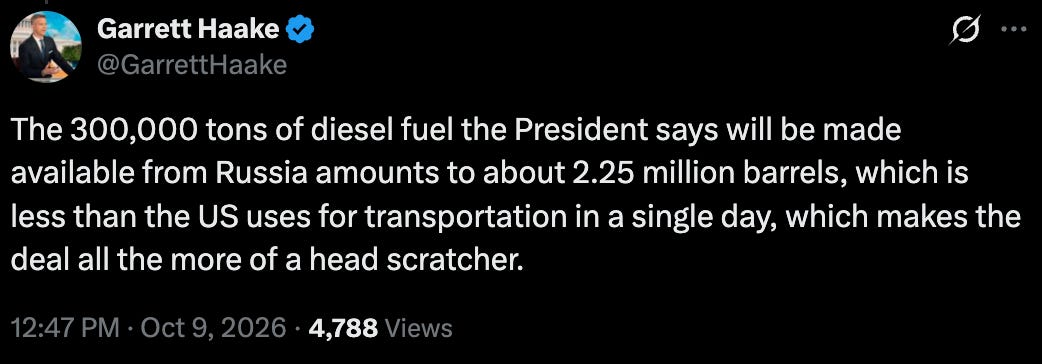
The first 300,000 tons translates to approximately 2.2 million barrels.
The additional 500,000 tons promised for November translates to approximately 3.7 million barrels.
For perspective, the initial shipment is less than the amount of diesel used for transportation in the United States in a single day.
NBC News correspondent Garrett Haake pointed out that discrepancy, calling the deal a head-scratcher.
Blas similarly observed that the quantities are quite small relative to the global energy market. The initial 300,000 tons would amount to roughly 100,000 barrels per day over the remainder of October, with the November shipment representing approximately 125,000 barrels per day.
These are modest additions in a global petroleum market that consumes more than 100 million barrels of oil and petroleum products every day.
And that’s assuming the promised deliveries actually materialize.
There are serious questions about Russia’s capacity to supply the quantities Trump is advertising.
Russia has experienced disruptions to its refining industry as Ukraine has intensified long-range drone attacks on facilities supporting Moscow’s economy.
Russia analyst Igor Sushko questioned whether the country even has sufficient surplus diesel available for export, describing the announcement as a publicity stunt intended to make Russia appear to be rescuing the United States.

Wholesale diesel prices reacted to Trump’s announcement, but an immediate market reaction is different from a sustained reduction in what Americans pay.
For now, the regime is making enormous promises about falling diesel prices while energy specialists are questioning whether the initial deal is large enough to deliver any meaningful relief.
Pre-order the new book from MeidasTouch, WTF America?!: The Way Out of This Hell and Back to Democracy, today, by clicking here.
Zelenskyy Accuses Trump of Using Ukraine as a “Smokescreen”
At the very moment Trump was announcing his agreement with Putin, Ukrainian representatives were in Miami meeting with members of Trump’s team, including Steve Witkoff and Jared Kushner, to discuss ending Russia’s invasion.
Now Zelenskyy is accusing Trump of using those negotiations as cover while reaching an agreement with the country attacking Ukraine.
In a voice memo sent to reporters, reported by the Financial Times’ Christopher Miller, Zelenskyy delivered an extraordinary rebuke of the American president.
“At this very moment—while our team is speaking with the American team in Florida—the President of the United States is talking to the Kremlin leader, the leader behind this war and this aggression, and is reaching an agreement allowing Russia to export diesel.”
Zelenskyy continued:
“This means additional funds for the war, additional funds to fuel the suffering inflicted upon us. Undoubtedly, this only emboldens Putin and enables them to continue fighting.”
He warned that the proceeds from Russian diesel sales could ultimately help finance continued attacks on Ukraine.
Then came his most serious accusation.
“I believe our team is simply being used as a smokescreen.”
Zelenskyy called the arrangement dishonest and said it was not how partners should behave.
He described it as “a weak decision—sadly, a weak decision made by strong partners.”
The Ukrainian president’s comments reveal the depth of the frustration in Kyiv.
Ukraine sent its delegation to Florida to negotiate with American officials about ending a devastating war. At the same time, Trump held a conversation with Putin and announced sanctions relief that could increase Russian energy revenues.
Zelenskyy is now publicly questioning whether Washington is negotiating in good faith.
He had already issued another forceful statement warning that easing sanctions against Russia without a clear and lasting de-escalation agreement would embolden Putin.
“Any easing of sanctions against Russia without a clear and lasting de-escalation agreement with Russia is an obvious weakness,” he said.
He warned that such a move would allow Russia to kill more people, wage war longer, show less respect for America, and inflict greater damage on the world.
Zelenskyy also outlined a specific reciprocal proposal: Ukraine would stop attacking Russian oil refineries and other energy facilities if Russia stopped destroying Ukraine’s energy infrastructure.
That proposal would reduce attacks on energy infrastructure by both sides.
Trump, meanwhile, has announced economic cooperation with Putin without publicly identifying any corresponding Russian commitment to stop attacking Ukraine.
Zelenskyy summed up his position with another warning:
“Gifts to Putin will not bring peace or any benefit to the civilized world.”
Is Trump Preparing to Protect Russian Refineries?
One detail in Trump’s announcement deserves particular attention.
Trump specifically referenced the condition of Russian diesel refineries when discussing the possibility of additional fuel deliveries.
Ukraine has been targeting Russian energy infrastructure with long-range drone strikes, damaging facilities that help sustain Moscow’s economy and military operations.
Those attacks have become an important component of Ukraine’s strategy for imposing economic costs on Russia.
By tying additional diesel supplies to the condition of Russian refineries, Trump has created a potential conflict between his energy agreement with Putin and Ukraine’s military strategy.

Will the administration now pressure Zelenskyy to stop striking Russian refineries so Putin can fulfill the promised diesel shipments?
Will American negotiators use the agreement as leverage against Ukraine?
Trump has not publicly announced any commitment to protect Russian refineries, and the full terms of his conversation with Putin have not been disclosed.
But the questions are unavoidable, particularly given Zelenskyy’s accusation that Ukraine’s negotiators are being used as a smokescreen.
The regime should explain whether refinery protection, Ukrainian drone strikes, or additional concessions to Russia were discussed during Trump’s conversation with Putin.
MeidasTouch Editor-in-Chief Ron Filipkowski Calls for Impeachment
MeidasTouch Editor-in-Chief Ron Filipkowski reacted furiously to Trump’s announcement, calling for Congress to block the agreement and for Trump to face impeachment.
Ron wrote:
“This is completely outrageous and disgusting. This must immediately be blocked by Congress and Trump should be impeached for this. The US is now funding Putin’s war machine as he murders civilians including children. We are lost as a country.”
His comments reflect the gravity of the concerns surrounding this decision.
Additional Russian energy sales could generate revenue that strengthens the broader Russian economy, which supports Putin’s military operations. The actual financial benefit will depend on how much fuel is sold, the prices paid, and the terms of the transactions.
But the sanctions policy reversal is clear.
For years, the United States and its allies have used economic restrictions to limit Russia’s ability to generate revenue from energy exports.
Now Trump is loosening those restrictions while Russia continues its invasion.
And he’s doing it as Russian missiles and drones continue striking Ukrainian communities.
Ron is calling for congressional intervention and impeachment over the decision.
What did Trump promise Putin? What did Putin offer in return? And why was sanctions relief authorized before any publicly announced Russian commitment to reduce attacks on Ukraine?
Trump Punished Other Countries for Buying Russian Energy. Now He’s Doing Business With Putin.
There is another glaring contradiction.
The Trump regime has pressured countries such as India over their purchases of Russian energy, threatening economic penalties against nations that continue trading with Moscow.
Now the United States is authorizing transactions involving Russian diesel, including imports into America.
New York Times columnist Nicholas Kristof highlighted the hypocrisy of Washington punishing other countries for purchasing Russian fuel while Trump announces an arrangement that permits additional Russian energy sales.
How is the United States supposed to persuade allies and trading partners to maintain economic pressure on Moscow when Washington is easing its own restrictions?
And what does this tell Putin about America’s willingness to sustain sanctions until Russia agrees to meaningful concessions?
The Kremlin has spent years trying to weaken Western sanctions and normalize its economic relationships with major powers.
Trump’s announcement gives Moscow an opportunity to portray Russia as an indispensable energy supplier at a moment when Western governments have been trying to isolate it economically over the invasion of Ukraine.
Putin’s economic envoy Kirill Dmitriev was quick to welcome the agreement, emphasizing the benefits of Russian-American economic cooperation.
The diplomatic value to Moscow is apparent even before the first shipment arrives.
Trump’s Energy Crisis Isn’t Going Away
The broader energy crisis remains unresolved.
The Strait of Hormuz has experienced severe disruptions amid the war with Iran, with attacks on commercial vessels and interruptions to regional energy production and shipping.
Trump’s claim of “TOTAL CONTROL” over the strait is difficult to reconcile with the continuing disruptions, and well, reality.
Energy analyst Gregory Brew raised an obvious question: If the United States has total control over Hormuz, why can’t more diesel be moved out of the Middle East and North Africa?
Regional energy output remains depressed.
American energy production has also faced additional disruptions from severe weather in the Gulf of Mexico.
The combination of damaged infrastructure, disrupted shipping, higher transportation costs, and uncertainty about future supplies continues to put pressure on global markets.
Against that backdrop, Trump is presenting a relatively modest initial supply of Russian diesel as though it will suddenly bring prices crashing down.
The economic impact remains uncertain, particularly with Russia’s own refining capacity under pressure.
But the political timing is clear.
The midterm elections are approaching. Americans are frustrated with energy prices. Trump needs to show that his regime is doing something to address the crisis.
And Putin has now provided him with an announcement he can promote as a breakthrough.
Congress Needs to Demand Answers
There are still major unanswered questions about this agreement.
The regime should disclose what was discussed during Trump’s conversation with Putin, whether any commitments were made regarding Ukrainian strikes on Russian refineries, and what concessions Russia offered in exchange for sanctions relief.
It should also explain how the promised diesel deliveries are expected to reduce American prices when energy analysts have questioned their scale.
Congress should examine the scope of the Treasury Department’s authorization, its duration, and its potential economic benefits to Russia.
And the regime needs to address Zelenskyy’s accusations directly.
Ukraine’s president has publicly accused Washington of using his country’s negotiators as a smokescreen while Trump reached an agreement with Putin.
That accusation cannot simply be ignored.
Trump claims he wants to end Russia’s war against Ukraine, yet he is easing restrictions on Russian energy exports without publicly securing a commitment from Putin to stop the attacks.
Trump claims he wants to lower American energy prices, yet the initial quantities of diesel involved are unlikely to make a meaningful difference in the global market.
And while Ukrainian officials negotiate with American representatives in Florida, Zelenskyy is accusing the United States of reaching agreements with Moscow behind their backs.
The most important question now is what Trump agreed to with Putin that has not yet been disclosed.
We’ll continue following the sanctions relief, the response from Ukraine, and what happens next with Trump and Russia.
Thank you for supporting MeidasTouch and independent journalism. Your support makes it possible for us to continue reporting on these developments and holding those in power accountable.


