



In the Soviet Union, life was cheap and the state mattered above all. Nowhere is that clearer than in northern Ukraine, where the wreckage of the world’s worst nuclear disaster still smolders beneath layers of steel and concrete — and where, nearly four decades later, Russia’s war has once again turned the land toxic.
I traveled to Chernobyl shortly after a massive wave of Russian drones and missiles rained down on Ukrainian cities. Accessing the exclusion zone surrounding the site is not easy. I met my escort, a young Ukrainian special forces major named Valeri [I have changed his name to protect his identity], at a gas station on the edge of the zone. From there, we crossed into a poisoned wasteland: 2,600 square kilometers of irradiated forests, ghost towns, and the crumbling remains of Soviet ambition.
“Wolves and Russians”
I asked Valeri why we needed an armed escort. Except for the nuclear technicians who monitor the reactor site, the zone has no people.
“It’s not people we worry about,” he said. “It’s wolves… and Russians.”
Before I could ask him to explain, his radio crackled. We were cleared to proceed to Pripyat, the once-thriving Soviet city built to house nuclear workers and their families. It was a rare opportunity — my hosts, I sensed, wanted me to see the truth of what the Russians left behind.
Into the Zone
Past the last checkpoint, Russian trenches scarred the woods, dug during the first weeks of the 2022 invasion. Signs nailed to trees warned of mines.
The highway narrowed as the forest closed in. What had been four lanes of concrete was reduced to two; the rest had disappeared beneath moss and roots. Through gaps in the trees, chimney stacks stood alone, the last skeletal reminders of wooden homes long since rotted away.
A peeling sign announced our arrival in Pripyat. This city of 45,000 was once a Soviet showcase, with free day care, an amusement park, and four massive reactors that helped power the empire. Another two reactors were under construction when catastrophe struck.
Our van stopped in a clearing, and we followed a path through the forest to a ruined restaurant on the riverbank. Inside, shattered glass crunched underfoot. One wall was an enormous stained-glass mural in the Socialist Realist style: a goddess sowing fields beneath a blazing nuclear sun. Even in its broken state, it rivaled the grandeur of Europe’s cathedrals.
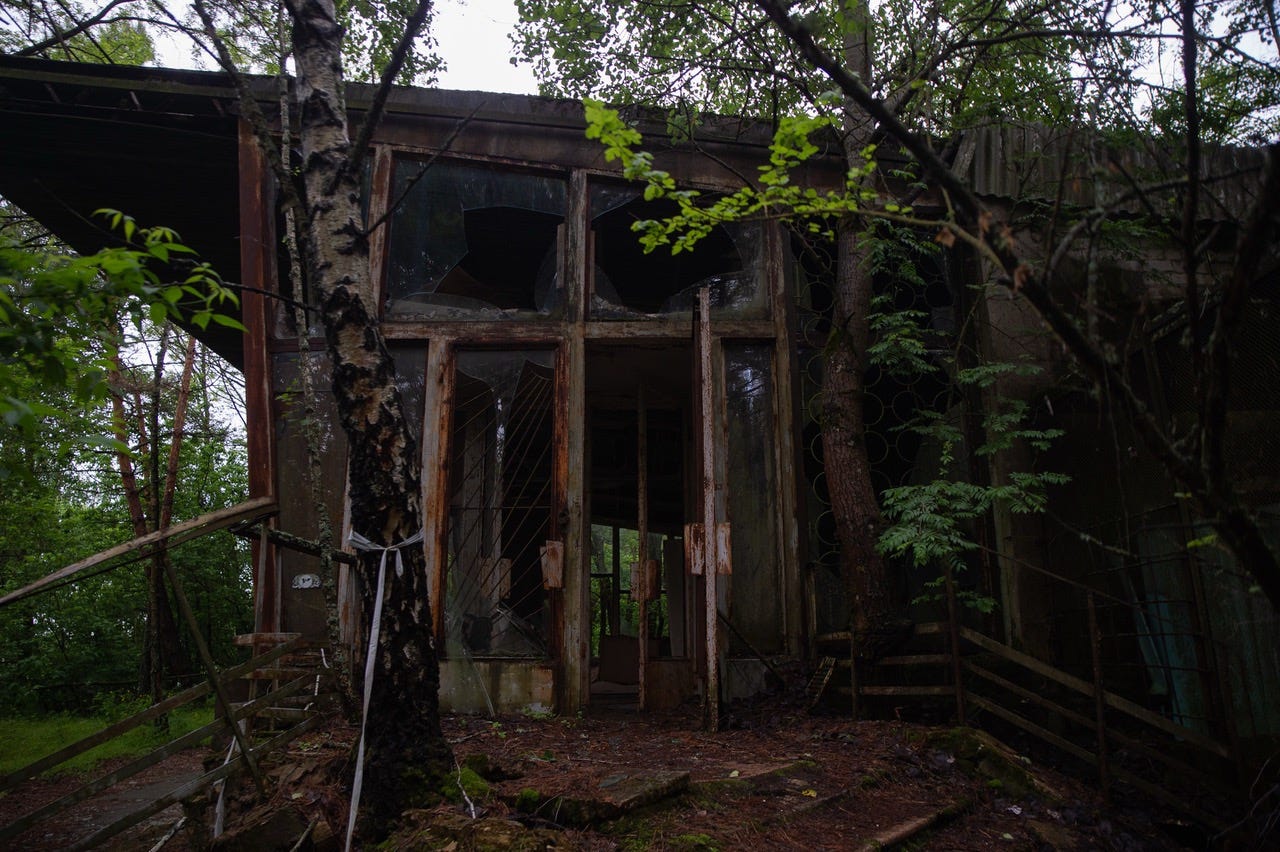
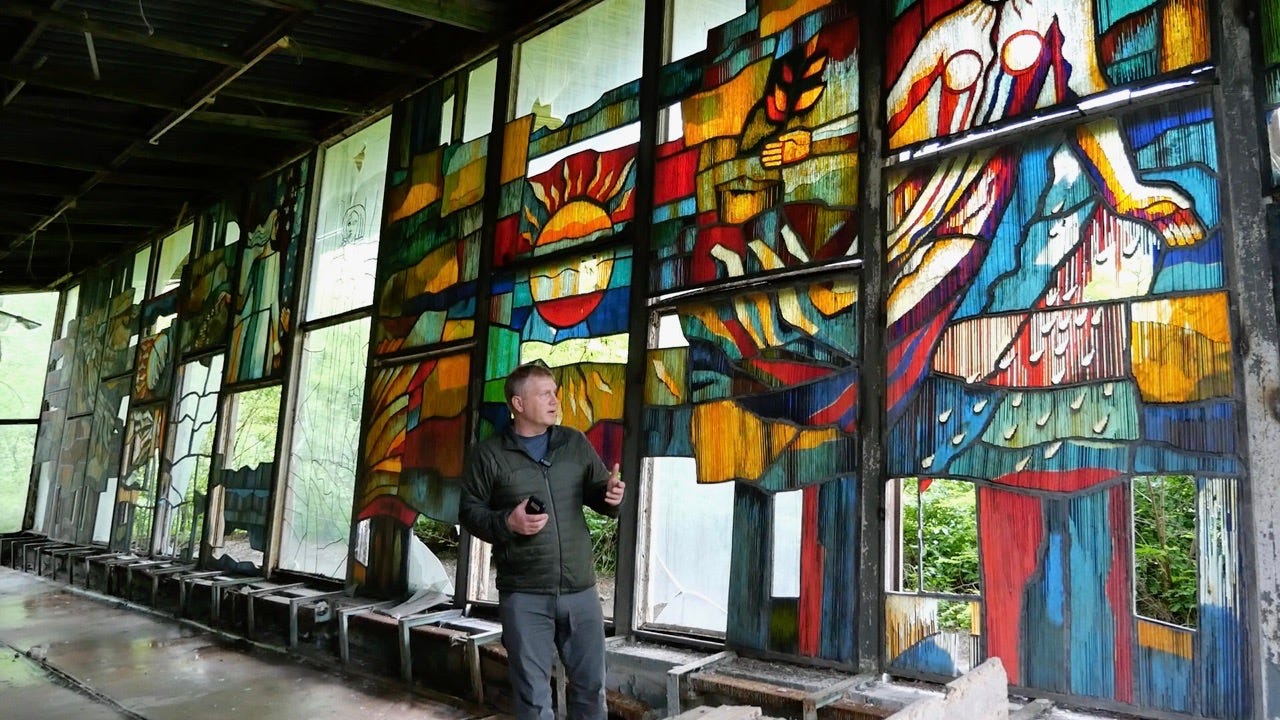
Valeri pointed across the water to a half-sunken dock. “That is where the Russian invasion began,” he said. In the first hours of the war, Spetsnaz commandos landed there and seized the nuclear plant. Weeks later, Ukrainian forces drove them back, but sabotage attempts continue. “They keep coming,” Valeri muttered. “If they cannot take Chernobyl, they will burn it.”
The Hospital
The hospital at Pripyat loomed from the forest, its Soviet slogan crowning the roofline in bold Russian Cyrillic: Health to the People, Wealth to the State. Valeri stopped at the door. “It dangerous inside,” he warned. “It is also a grave — be respectful. And do not go into the basement.”
Inside, the air was heavy and damp. Mold spread like bruises across the walls. In one room, glass test tubes lay scattered across the floor; in another, files sprouted fungus where they spilled from a cabinet.
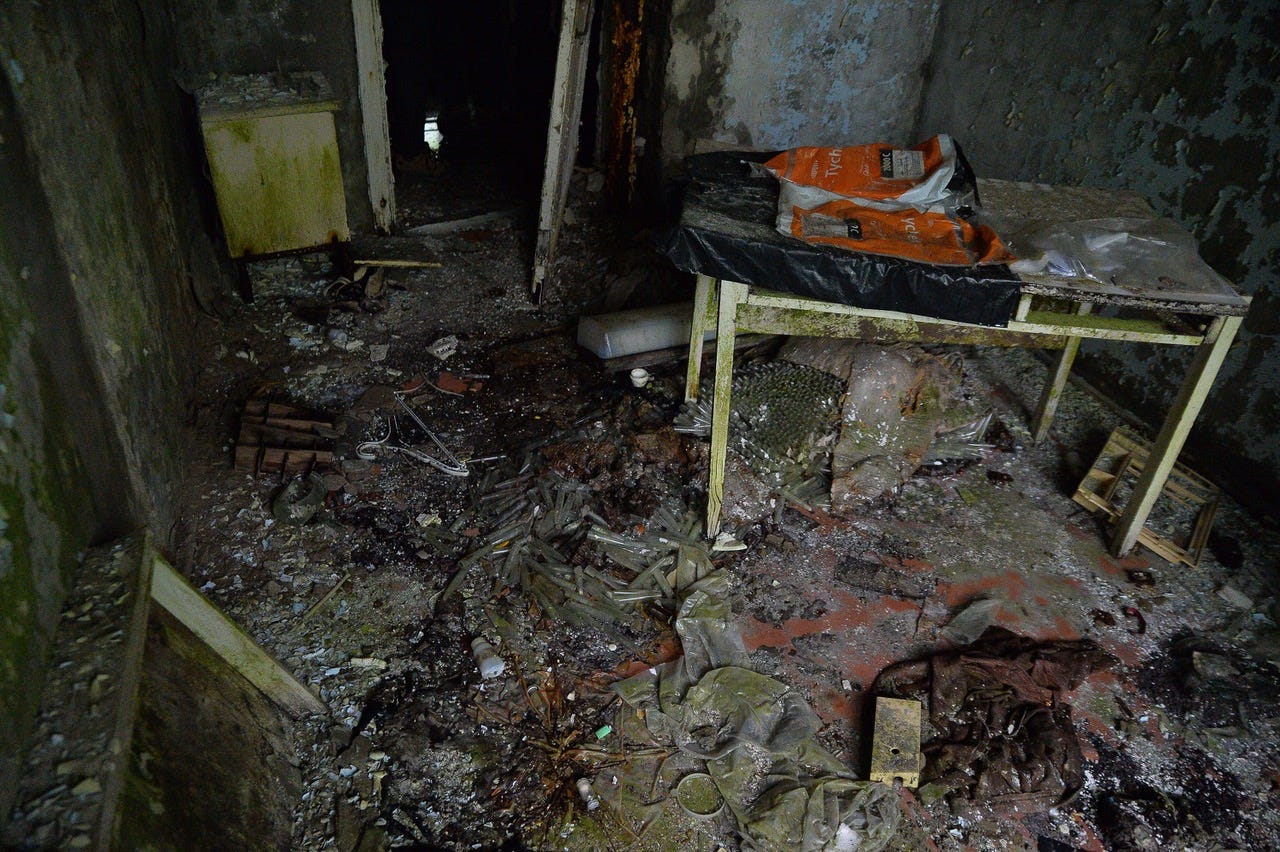
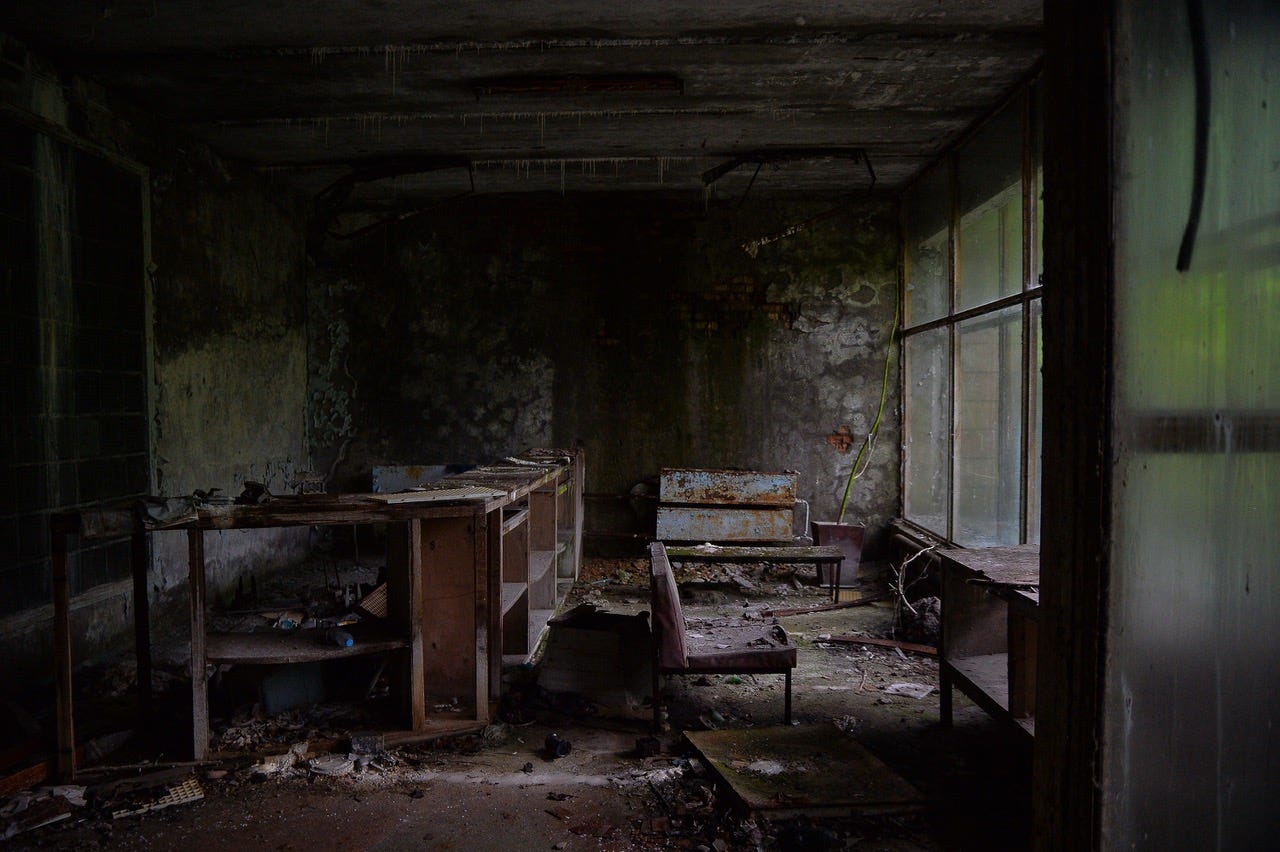
This was where firefighters were treated after they rushed to douse Reactor Four’s flames. Their clothing — saturated with deadly particles — was carried to the basement and left in piles. To this day, those boots and jackets are among the most radioactive objects on earth.
I tried to imagine the frantic doctors, the chaos of that April night in 1986. But the building seemed to resist my curiosity. The silence pressed in, whispering to me: Get out.
I understood why Valeri waited outside.
Fire and Silence
We drove away in silence until Valeri gestured to a blackened stretch of forest. Charred trunks stood like gravestones. Between them, new saplings pushed through.
“Russians,” he said. “When we stop them from reaching the plant, they set fires.” His voice dropped to a mutter: nedolyuds’ki diiavoly — subhuman devils.
The weight of his words lingered as we passed deeper into the zone.
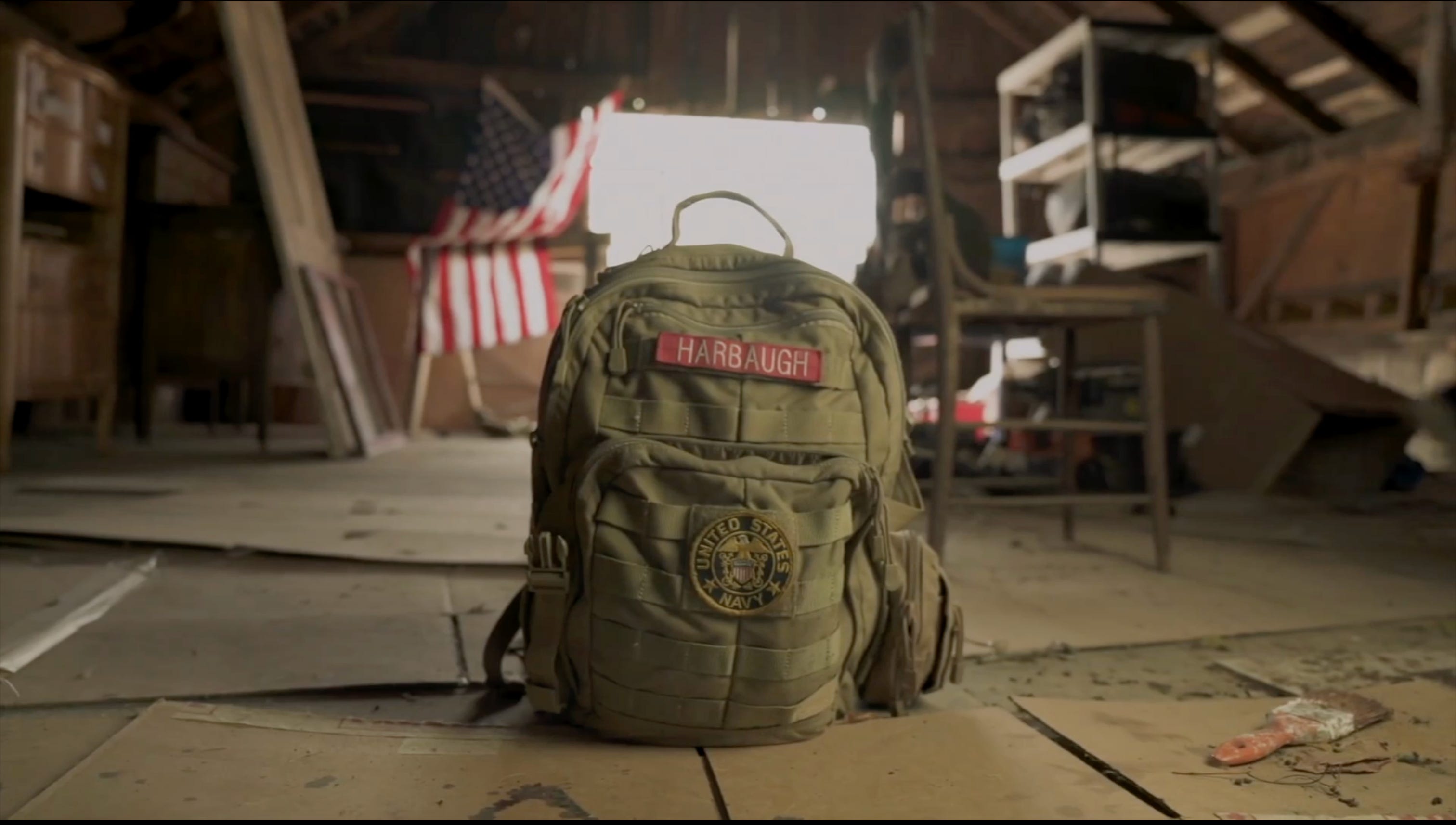
Check here tomorrow for Part II of Ken Harbaugh’s report on Chernobyl, and the mutant wolves that now roam the radioactive wasteland. For more from Ken Harbaugh, subscribe to his Substack here:
Your support of the Meidas+ Substack allows us to bring you reports like this. Consider joining now as a paid subscriber to keep us going.
I remember seeing Trump supports at rallies prior to the 2016 election wearing tee shirts “I’d rather be in Russia than with liberals.” Anyone remember that?
Defeating the fascists in WWII did not happen without sacrifice from the citizens of the Allied countries. We will have to sacrifice to stop and reverse the fascist takeover of our country. We can sacrifice a little now or a much greater amount later. What kind of world will our children and grandchildren live in if we allow this to continue?
Spending Strike, Spending Freeze, Spending Suspension, Spending Pause, Economic Disengagement, Economic Warfare, Stop Spending!, even Boycott. Choose your favorite but Do It, and Spread the Word!
If a single dollar doubles every day for 30 days, it reaches a total of over $536 million ($536,870,912) at the end of the 30th day.
So, would it follow, that a single voice that doubled everyday would become 536 million voices after 30 days? That seems doable.
From Mark Mansour:
Sacrifice has always been the price of renewal. Democracy, if it is to survive, cannot be the cheap luxury item of a populace too comfortable to fight for it. The Trump regime can be resisted through civic courage, legal challenge, and organization. But it can also be starved—one deliberate, withheld dollar at a time.
https://open.substack.com/pub/mmansour/p/its-time-to-recognize-that-this-ordeal?r=5f62tm&utm_medium=ios