



Hi all, I hope your New Year’s Eve is going well. I wanted to make sure you are up-to-date on all the latest stories as we head into 2026. I’ll try to keep this brief.
On New Year’s Eve, we learned that the Justice Department is now reviewing more than 5 million pages of records tied to Jeffrey Epstein that were never previously turned over. Based on what I’ve seen, and if you’ve been following our reporting, we know this is likely only the floor, not the ceiling.
According to reporting confirmed this morning by the New York Times, the Department of Justice is now reviewing approximately 5.2 million pages related to the Epstein investigation. How convenient that millions of documents just keep “appearing!”
Federal officials are reportedly scrambling to enlist roughly 400 lawyers to make go through the material, with a tentative timeline stretching into late January. This is not some tidy batch of files that was overlooked. This is a sprawling universe of records that raises urgent questions about why the public was told, just days before Christmas, that the total amounted to around one million.
That earlier number never made sense. And it turns out it didn’t because it wasn’t true.
Back in December, when only a tiny fraction of Epstein-related materials were produced, we pointed out something critical. In 2020, federal prosecutors in the Southern District of New York acknowledged that one single hard drive associated with Epstein contained roughly 1.2 million records. That was just one device. As an attorney, I’ve handled large-scale litigation and document productions, so I knew quickly what that implied. Any attorney worth his or her salt would know the same. Multiple hard drives, backups, mirrored systems, and cloud storage can quickly turn “records” into tens of millions of underlying pages.
That is why today’s revelation matters so much. It confirms that what the public has been given so far is a sliver of the truth. And “coincidentally,” when I called these missing documents out during our reporting, the DOJ suddenly “found” them.

At the same time this document review is exploding in scale, devastating new reporting has landed about Epstein’s relationship with Trump and Trump’s private club. The Wall Street Journal reported that Epstein was not merely a frequent presence at Mar-a-Lago in the late 1990s and early 2000s. According to former employees, the club actively sent young female spa workers to Epstein’s nearby mansion for “house calls.” These visits went on for years.
Employees warned each other about Epstein. Managers warned employees that he might expose himself during appointments. And yet the house calls continued.
Let’s be clear about what former workers described. They are describing sexual assault and sexual exploitation facilitated through Trump’s private club. This was not hidden. It was known. It was normalized. And it was allowed to continue.
The Journal’s reporting also confirms that Marla Maples, Trump’s second wife, raised concerns about Epstein’s behavior. Trump ignored them, until he couldn’t any longer. His relationship with Epstein outlived that marriage. Even when questions arose internally about why Epstein could not simply be barred from the spa, workers were told that Epstein preferred services in the privacy of his own home.
This context matters deeply when we remember how Epstein recruited and abused minors. In 2000, Virginia Giuffre, then underage, was recruited at Mar-a-Lago by Ghislaine Maxwell and sent to Epstein’s home. Her story is now tragically cut short by her death by suicide. Imagine the lives that could have been saved if Epstein’s behavior was dealt with sooner.
And while this reckoning unfolds, Trump’s conduct as president continues to disgrace the country on a daily basis.
New reporting from the New York Times also details how Trump’s promise to end the war in Ukraine in 24 hours collapsed into farce and humiliation. The article recounts a moment that should haunt every American, and it’s a moment I keep bringing up in our reporting because I will never let Trump erase his actions from that day. Trump rolled out the red carpet for Vladimir Putin and orchestrated a scene in which American soldiers were forced to kneel while Putin stood over them. It is one of the most degrading images in modern U.S. history, and one that authoritarian regimes will replay for decades. American troops. On their knees. Rolling out the red carpet. For Vladimir Putin. Sorry if I keep going on about this, but I will never get over it.
After that meeting, when Ukrainian President Volodymyr Zelenskyy visited the Oval Office, Trump fixated not on security, sovereignty, or democracy, but on how “beautiful” Ukrainian women are. He bragged about pageants, ownership, and connections, even attempting to put a former Miss Ukraine on the phone. Zelenskyy responded with humanity, speaking about families who stayed behind in Odesa and the meaning of national identity under attack, doing his best to recenter the conversation to what matters and away from Trump’s, well, creepiness.
At home, Trump’s rage has turned openly vindictive, and even his own party is getting burnt. On New Year’s Eve morning, he posted that Colorado’s governor and a Republican district attorney should “rot in hell” for refusing to free Tina Peters, a convicted MAGA election fraudster who tampered with voting machines after the 2020 election. Trump yesterday vetoed a bipartisan clean water bill that would have delivered safe drinking water to 50,000 people in Colorado, including many in Lauren Boebert’s district (Boebert was a co-sponsor of the legislation). That veto followed Boebert’s role in pushing for the release of the Epstein files. The retaliation, whether for Boebert’s Epstein vote, or Colorado’s refusal to release Peters, is obvious.
The economic fallout of Trump’s presidency is accelerating as well. China has imposed a 55 percent tariff on imported American beef while sharply reducing purchases of U.S. soybeans. Under Trump, China bought far fewer soybeans than it did under former President Biden, and now American farmers are being squeezed further as China turns to suppliers like Australia, Brazil, and Argentina.
Meanwhile, billionaires are thriving. The United States now has over 900 billionaires, whose combined wealth surged 18 percent this year to nearly $7 trillion, according to UBS. For everyone else, wages lag, costs rise, and social programs are targeted. The distraction playbook is familiar, and far too many are falling for it. Pit communities against each other while wealth concentrates at the top and accountability disappears. It’s classic divide, distract, and conquer.
In other news, the House Judiciary Committee has finally released the 255-page transcript from its deposition of Jack Smith about Trump’s crimes. I am reading through it now, and will publish my report shortly on our YouTube channel. We have also obtained the full 8-hour video of the deposition. You can watch it now on our YouTube channel.
Here’s a quick summary of the deposition that Aaron Parnas wrote for us over at MeidasNews.com:
The House Judiciary Committee on Tuesday released the full deposition transcript of former Special Counsel Jack Smith, offering the most detailed public account yet of Smith’s rationale for prosecuting Donald Trump and rebutting Republican claims that the investigations were politically motivated.
Across hours of sworn testimony, Smith mounted a detailed and unapologetic defense of his prosecutorial decisions, repeatedly underscoring that the charges were driven by evidence, not politics, and that he would have brought the same cases regardless of party affiliation.
Here’s the summary:
DOJ Limits and Sealed Material
At the outset of the deposition, Smith’s counsel made clear that his testimony was constrained by legal restrictions imposed by the Department of Justice and the courts. According to representations made to the committee, DOJ interpreted Federal Rule of Criminal Procedure 6(e) narrowly, limiting grand jury secrecy to internal grand jury matters and making it virtually impossible for Smith to be prosecuted for violating those rules.
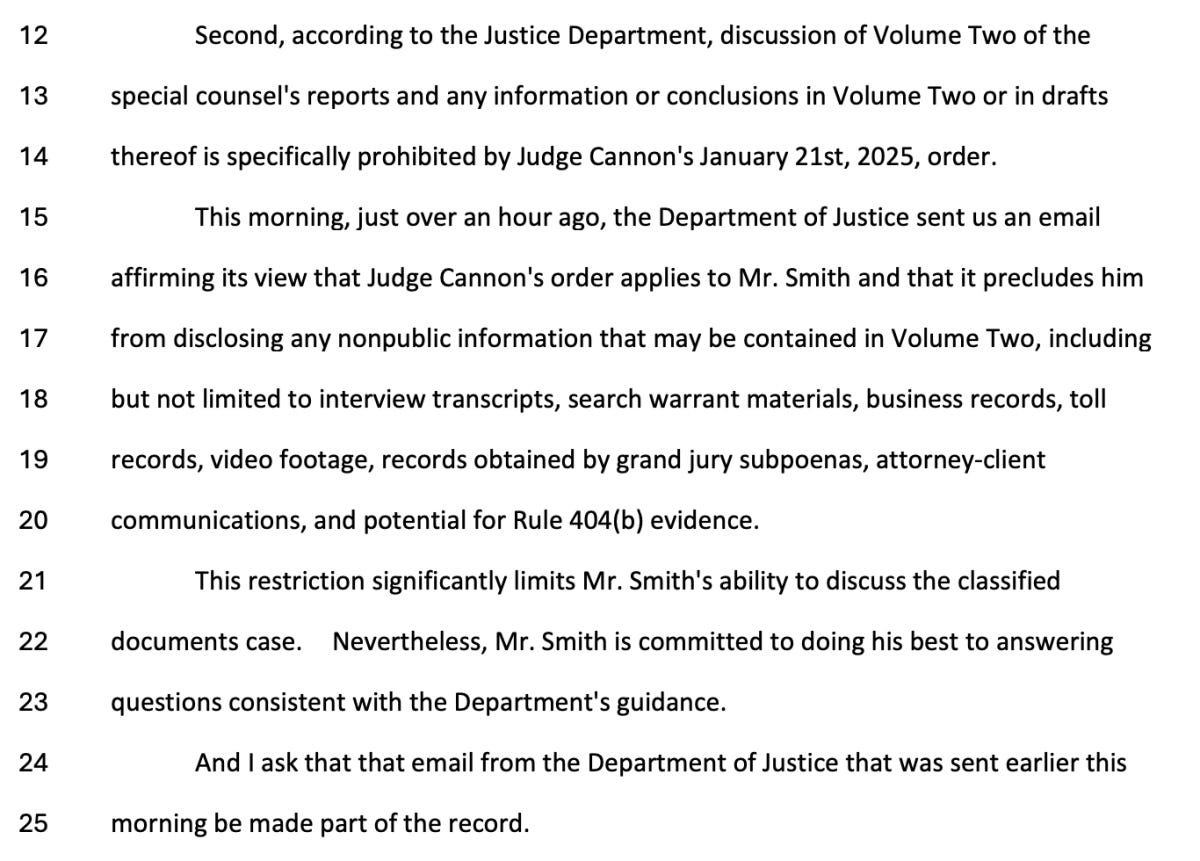
More significantly, DOJ instructed Smith that a January 21, 2025 order by Judge Aileen Cannon barred him from discussing any nonpublic material contained in Volume Two of the Special Counsel’s final report, including interview transcripts, search warrant materials, toll records, and grand jury evidence. As a result, Smith was unable to provide detailed testimony about the classified documents case, though he pledged to answer questions consistent with DOJ guidance.
“The Decision Was Mine”
In his opening statement, Smith took direct responsibility for the decision to charge Trump, while placing responsibility for the underlying conduct squarely on the president.
“The decision to bring charges against President Trump was mine,” Smith said, “but the basis for those charges rests entirely with President Trump and his actions, as alleged in the indictments returned by grand juries in two different districts.”

Smith testified that his investigation developed proof beyond a reasonable doubt that Trump engaged in a criminal scheme to overturn the results of the 2020 election and obstruct the lawful transfer of power. He also said investigators uncovered powerful evidence that Trump willfully retained highly classified documents after leaving office, storing them at Mar-a-Lago in locations including a ballroom and a bathroom, and repeatedly obstructed efforts to retrieve them.
Smith rejected claims that his actions were influenced by the 2024 presidential election, stating that he acted without regard to Trump’s political beliefs, associations, or candidacy.
Confidence in the Evidence
Addressing criticism over the timing and speed of the prosecutions, Smith said the pace reflected the strength of the evidence and his confidence that his team would have secured convictions at trial.
“If asked whether to prosecute a former President based on the same facts today,” Smith said, “I would do so regardless of whether that President was a Republican or a Democrat.”
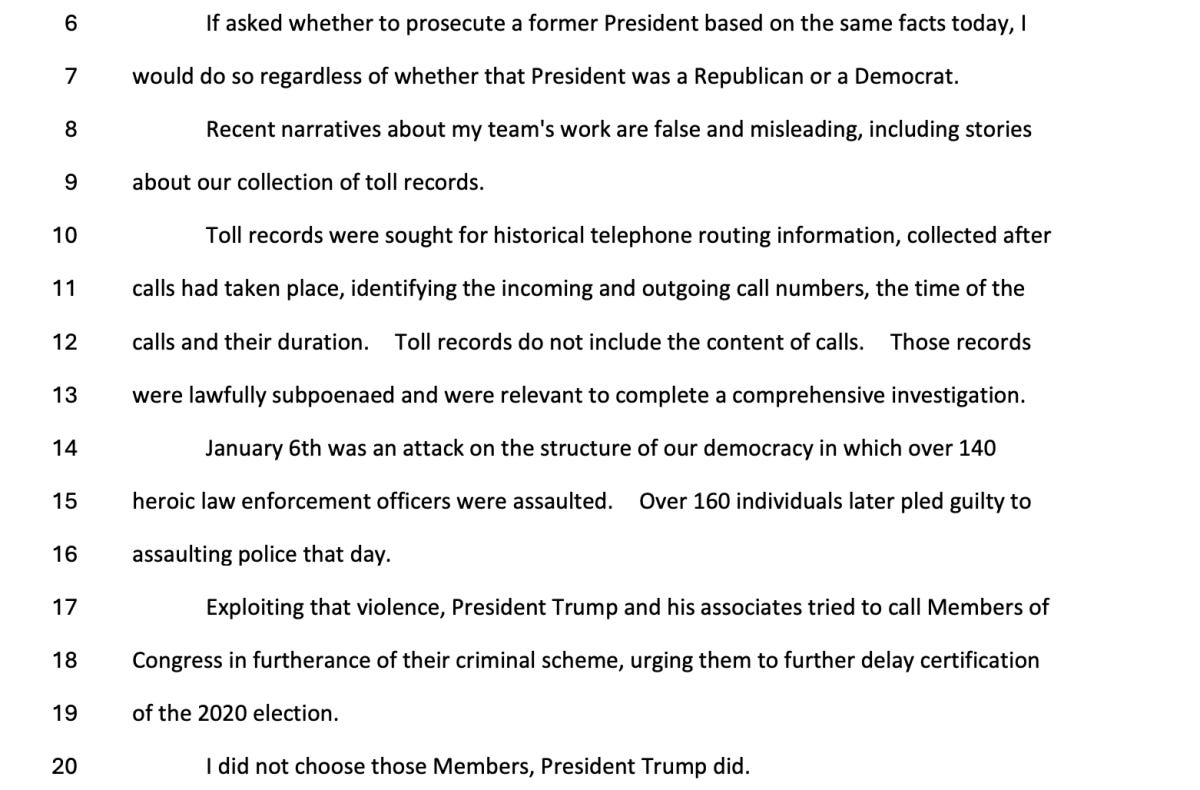
Smith also pushed back against allegations surrounding his office’s collection of toll records, emphasizing that such records contained only noncontent information, including phone numbers, call times, and durations, and did not include the substance of any conversations. He said the records were lawfully subpoenaed and necessary to complete a comprehensive investigation.
January 6 and Congressional Pressure
Smith described January 6, 2021, as an attack on the structure of American democracy, noting that more than 140 law enforcement officers were assaulted and over 160 individuals later pleaded guilty to assaulting police officers.
He testified that Trump and his associates exploited the violence by attempting to contact Members of Congress to delay certification of the 2020 election results.
“I did not choose those Members,” Smith said. “President Trump did.”
First Amendment Dispute
A central exchange during questioning focused on whether Trump’s false election fraud claims were protected by the First Amendment. Smith flatly rejected that characterization.
“If they are made to target a lawful government function and they are made with knowing falsity, no, they are not,” Smith testified. While acknowledging that Trump was free to claim he won the election, even falsely, Smith said he was not free to use knowingly false statements to obstruct lawful government processes.

“There is no historical analog for what President Trump did in this case,” Smith said.
Republican Witnesses Against Trump
Smith emphasized that one of the strongest aspects of the prosecution’s case was its reliance on Republican witnesses and Trump allies, not political opponents.
“We had numerous witnesses who would say, ‘I voted for President Trump. I campaigned for President Trump. I wanted him to win,’” Smith testified, citing Republican legislative leaders in Arizona and Michigan and a Pennsylvania elector who described the scheme as illegal and an attempt to overthrow the government.
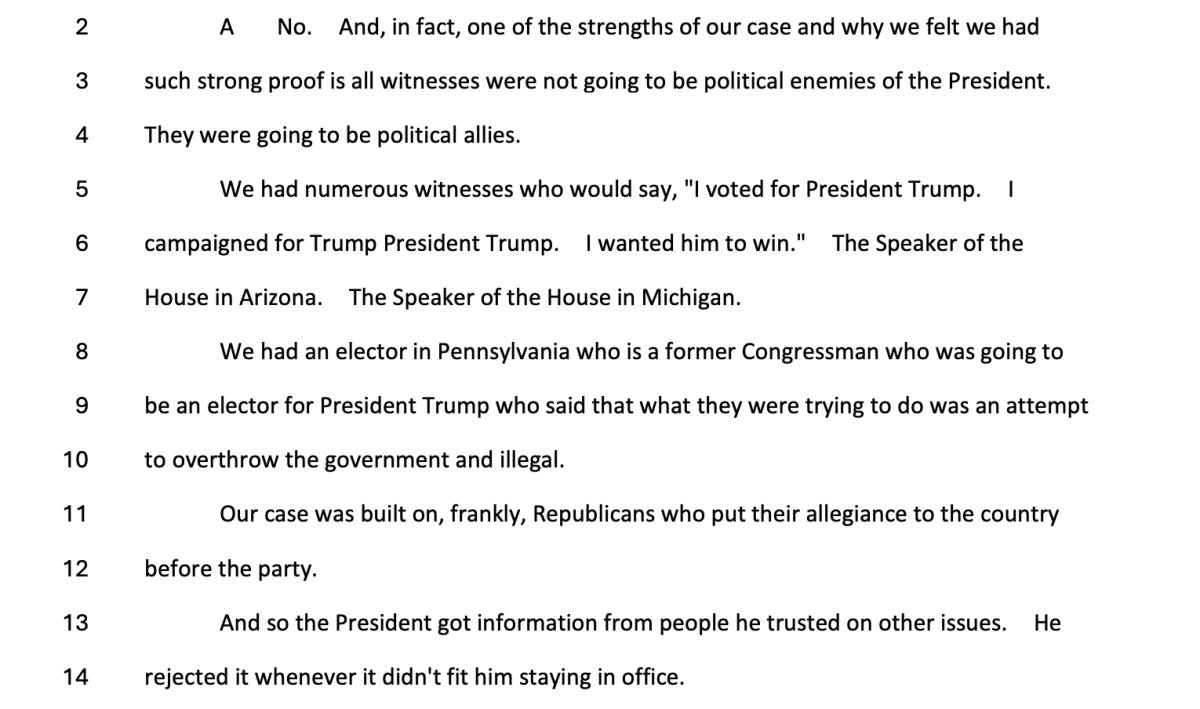
According to Smith, Trump repeatedly rejected accurate information that contradicted his effort to remain in office while embracing far-fetched legal theories that supported that goal.
Responsibility for January 6 Violence
When pressed on Trump’s role in the Capitol attack, Smith testified that while Trump did not explicitly order the breach, the violence was foreseeable and exploited.
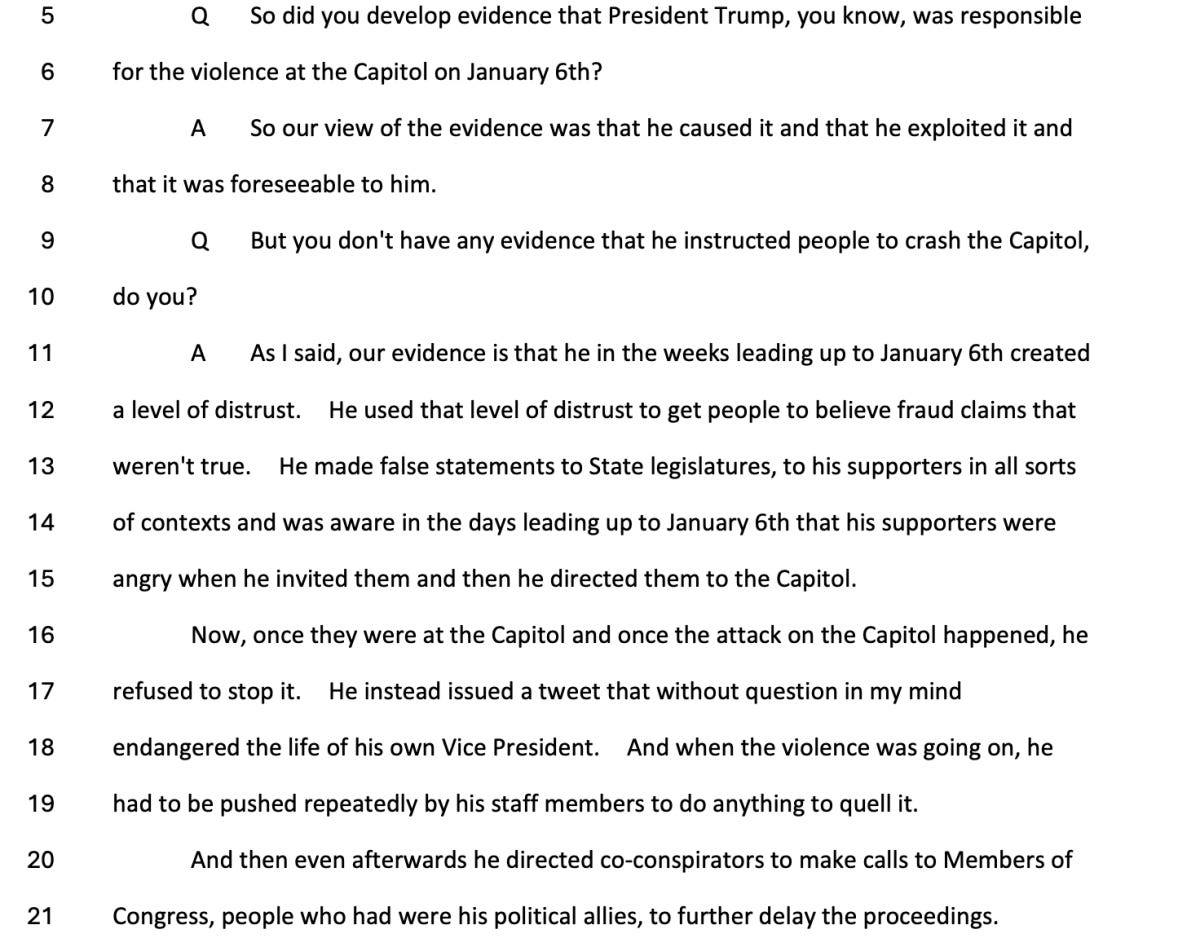
Smith said Trump spent weeks fueling distrust, invited angry supporters to Washington, directed them to the Capitol, and then failed to act decisively once violence erupted. He also testified that Trump later encouraged allies to pressure Members of Congress to further delay certification.
A Record Defense
Taken together, the deposition transcript presents Smith’s most comprehensive public defense of the Trump prosecutions to date. It frames the cases as evidence driven, legally grounded, and insulated from partisan considerations, even as Republicans on the committee continue to challenge their legitimacy.
Thanks again for all your support this year and thank to all who have become paid subscribers. It’s thanks to you that we are able to continue to expand our team, grow our newsroom, and hold this regime to account.


