


… Trump posted on Truth Social today that Americans shouldn’t be concerned about high gas prices: “The United States is the largest Oil Producer in the World, by far, so when oil prices go up, we make a lot of money.”
… The multi-national oil companies operating in the US make a lot of money. The average American gets screwed. Which pretty much sums up Trump and the Republican Party’s approach to the economy.
… Sen. Andy Kim (D-NJ): “The people I talk to are thinking about their grocery prices, housing prices. They’re not thinking about how much money American corporations are going to make off of higher oil prices, because that’s just gonna raise all of our prices at home. That’s where the president is just so detached.”
… Gas market analyst Patrick De Haan: “Americans today will spend roughly $250 million more on gasoline than they did 30 days ago.”
… Sen. Brian Schatz (D-HI): “I have spent the last 6 days discussing with experts strategies to bring down the price of oil, fertilizer, and other key commodities necessary for modern life, and here are my preliminary findings. 1) End this stupid war.”
… Podcaster Joe Rogan: “This war with Iran is terrifying. And it’s exactly the opposite of what we were told leading into this admin, that it’s gonna be America First and then no more unnecessary foreign wars. If oil prices spike, we’re fucked. And the Republicans are really fucked.”
… Trump said he’s been briefed on Iranian terrorist sleeper cells inside the US: “We know where most of them are, we’ve got our eye on all of them - I think.”
… Trump posted what many have interpreted as a threat to the members of the Iranian National Soccer Team: “The Iran National Soccer Team is welcome to The World Cup, but I really don’t believe it is appropriate that they be there, for their own life and safety.”
… NYT: “On Feb. 18, as Trump weighed whether to launch military attacks on Iran, Chris Wright, the energy secretary, told an interviewer he was not concerned that the looming war might disrupt oil supplies in the Middle East and wreak havoc in energy markets. Even during the Israeli and US strikes against Iran last June, Wright said there had been little disruption in the markets: ‘Oil prices blipped up and then went back down’.”
… “Some of Trump’s other advisers shared similar views in private, dismissing warnings that - the second time around - Iran might wage economic warfare by closing shipping lanes carrying roughly 20% of the world’s oil supply. The extent of that miscalculation was laid bare in recent days, as Iran threatened to fire at commercial oil tankers transiting the Strait of Hormuz. Commercial shipping has come to a standstill in the Gulf, oil prices have spiked, and the Trump admin has scrambled to find ways to tamp down an economic crisis that has triggered higher gas prices.”
… “The episode is emblematic of how much Trump and his advisers misjudged how Iran would respond to a conflict that the govt in Tehran sees as an existential threat. Iran has responded far more aggressively than it did during last June’s 12-day war, firing barrages of missiles and drones at US military bases, cities in Arab nations across the Middle East, and on Israeli population centers.
… Geopolitical analyst Shaeil Ben-Ephraim: “The effect Iranian attacks have had on oil production in the region are nothing less than stunning. Here is a partial list:
1) Iraq suspended all oil terminal operations and reduced oilfield production due to a lack of storage capacity as the Strait of Hormuz remains effectively closed.
2) Saudi Arabia halted operations at the Ras Tanura refinery, the world’s largest, following drone strikes and cut production at several oilfields.
3) Iran itself shutdown multiple oil and gas facilities following retaliatory strikes from the US and Israel.
4) Kuwait reduced output at major oilfields as a direct result of being unable to ship crude through the blocked Strait of Hormuz, leading to full storage tanks.
5) Qatar halted production at its largest natural gas facility, which often produces associated oil/condensates, following targeted strikes.
This is the LARGEST disruption of oil in history. Far larger than in the 1973 oil crisis. If this continues to the end of the month, Goldman Sachs predicts that prices could exceed the 2008 peak of $147 per barrel.”
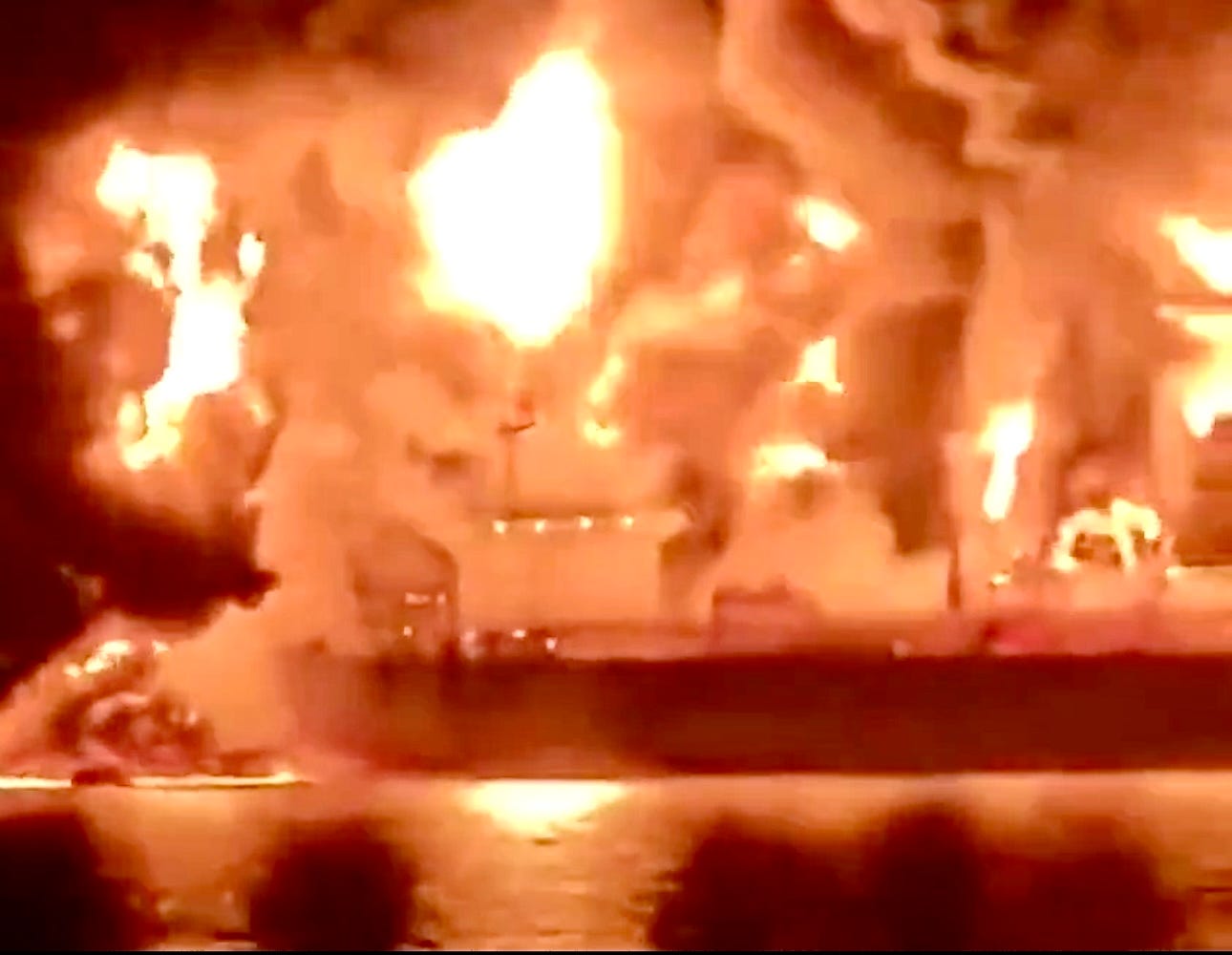
… Chris Wright on CNBC: “We’re gonna bring oil to market through other avenues to get through a few weeks of a short-term dislocation. You’ve got to go through short-term pain to solve a long-term problem. This is bold leadership from President Trump. This is what the world needs.”
… Q - “People would love to see the Navy escort tankers. Earlier this week, from a X post it looked like that was happening, but then it wasn’t happening. Why wasn’t it happening? Wright: It’ll happen relatively soon, but it can’t happen now. We’re simply not ready.”
… AP: “The Pentagon tells press the first week of the war cost $11.3 billion.”
… AL-Monitor: “This is very much devolving into a regional war. Trump messages of confidence that Iran war (‘excursion’) going ‘ahead of schedule’ and US running out of targets seem more of a smoke screen. Situation only escalating with Hezbollah firing > 100 rockets at Israel, Israel threatening Lebanon’s infrastructure, hitting inside Beirut, whole GCC paralyzed and major global shipping route cut.”
… “Not sure how this was not anticipated since IRGC spent years threatening exactly this: closing Hormuz, hitting regional countries. Countries hit on day 12 of the Iran War:
Oman
Kuwait
UAE
Saudi Arabia
Qatar
Bahrain
Iraq
Iran
Israel
Lebanon
+ Strait of Hormuz
… WSJ: “One nightmare scenario, in particular for America’s Gulf partners now bearing the brunt of Iranian attacks, is that the US and Israel would stop, then Iran would continue harassing strikes to cow these oil-rich monarchies into submission. The fear is that Tehran will try to pressure them to expel US bases and sever their dependence on an America that failed to protect them.”
… Dania Thafer, executive director of the Gulf International Forum: “There are many dangers. A wounded, angry Iran is not the best-case scenario for the Gulf states. While the US has to a large degree castrated Iran in terms of its ability to attack Israel, this gives Iran only one other option: to attack the Gulf states and to weaponize the Strait of Hormuz. Militarily speaking, the US is on the winning side. But politically speaking, the US and Israel have really gotten nowhere when it comes to Iran.”
… Steve Tsang, director of the SOAS China Institute in London: “This war hugely damages US standing in the world, which means that China has much more scope to establish its own standing in the Middle East and the Global South generally. Meanwhile, everyone is observing that Iran has, at best, a middling military capability - and the Americans still can’t take them out.”
… Brian Katulis, a senior fellow at the Middle East Institute: “America and Israel are witnessing the limits of what air and naval power alone can do. Strategic priorities, like opening the Strait of Hormuz and securing what remains of Iran’s nuclear stockpile, will likely require some ground troops if no diplomatic options are pursued. What we are looking at is potentially a very messy situation.”
… WSJ editorial: “Not only do we need hostilities to stop, but also shipowners to perceive that the risk to the people on board and to the ships has been materially reduced. Think about the Red Sea: Six months after the Houthis stopped the attacks, and traffic has not normalized. It’s all about perception of safety. And we are far away from that.”
… Reuters: “The US may have pulled the trigger on the Iran war, but it is the oil-producing Gulf that will pay the price, signaling unease in ties between a region under Iranian attack and the superpower it relies on for protection. Behind the scenes, resentment is mounting in Gulf Arab capitals at being drawn into a war they neither initiated nor endorsed but are now paying for economically and militarily, with airports, hotels, ports and military and oil installations hit by Iranian strikes.”
… Ebtesam Al-Ketbi, President of the Emirates Policy Center: “It is not our war. We did not want this conflict, yet we are paying the price in our security and our economy. If America leaves the war now without achieving victory, it will be like abandoning an injured lion. Iran will remain a threat to the region, capable of striking again. And if the regime collapses, leaving a power vacuum, neighbouing states will suffer the consequences.”
… Zelensky on his offer that Trump rejected last Aug to provide the US with cheap drone interceptors: “We wanted to sign a big drone production deal with the US, but we needed the approval from the WH. It was about different kinds of drones and air defense. They operate as one system and can defend against hundreds or thousands of Iranian shaheds and missiles. We didn’t have the opportunity to sign this document yet. I hope that maybe American friends will be closer to this decision now, especially after such challenges as we see in the Middle East.”
… WSJ: US officials say Iran has laid mines in the Strait of Hormuz. Just yesterday, the US said there was no indication that Iran was laying mines in the Strait of Hormuz. The mines are being described as the ‘most destructive weapons’ that the US Navy has faced.
… Geopolitical analyst Shanaka Perera: “The most expensive warship ever built just caught fire in its laundry. USS Gerald R. Ford, the flagship of American naval power in the Middle East, experienced a fire in its main laundry spaces while operating in the Red Sea in support of Operation Epic Fury. Not combat-related, contained, two sailors treated for non-life-threatening injuries, carrier remains fully operational.”
… “A laundry fire. On a $13.3 billion aircraft carrier. In a war zone. 9 months into a deployment that began in June 2025 and has been extended so many times it is approaching Vietnam-era records. It is burning because a warship designed for 6-month deployments has been at sea for 9 months in the most operationally demanding theatre on Earth, running sorties around the clock, and the systems that keep 4,500 sailors fed, clothed, and operational are being ground down by tempo.”
… “The IRGC’s cost calculus is not about sinking carriers. It never was. It is about exhausting them. A $20,000 drone that forces a $13.3 billion carrier to maintain combat air patrols 24 hours a day for 9 months does not need to hit the ship. It needs to wear out the laundry machines, the galley equipment, the HVAC systems, the sewage processing, and the 4,500 human beings who operate them until something catches fire at 1 AM on month nine.”
… “The fire is out. The war is not. And the laundry machines on the most expensive warship ever built just told the Pentagon what the IRGC already knows: attrition is not about weapons. It is about time.”
The war continues to dominate the news, although I did my best to find a few other interesting things in the back half of today’s Bulletin. If you missed yesterday’s podcast Uncovered where I do a deeper dive into the top stories happening right now, you can find it here. If you missed the last Bulletin, you can find it here.
Tomorrow is also Ask the Editor where I answer 5 questions from you. Please submit any question you may have or something you would like me to comment more on below. Thank you to everyone who supports my work by reading, sharing and subscribing.
… Al Jazeera: “Iran’s IRGC has threatened to attack ‘economic centers and banks’ related to US and Israeli entities in the region after what it called an attack on an Iranian bank. A spokesperson for the Khatam al-Anbiya said that ‘the enemy left our hands open to targeting economic centers and banks belonging to the US and the Zionist regime in the region. People of the region should not be within a one-kilometer radius of banks”.
… “Iran stated that US and Israeli forces have bombed nearly 10,000 civilian sites in the country and killed more than 1,300 civilians, since the war began. The IRGC-affiliated Tasnim news agency released a list of offices and infrastructure run by top US companies with Israeli links whose technology has been used for military applications, describing them as ‘Iran’s new targets’.”
… Spokesman Ebrahim Zolfaqari: "Get ready for oil to be $200 a barrel, because the
