


Guest article by Zarina Zabrisky, Meidas Defense’s Kherson-based correspondent
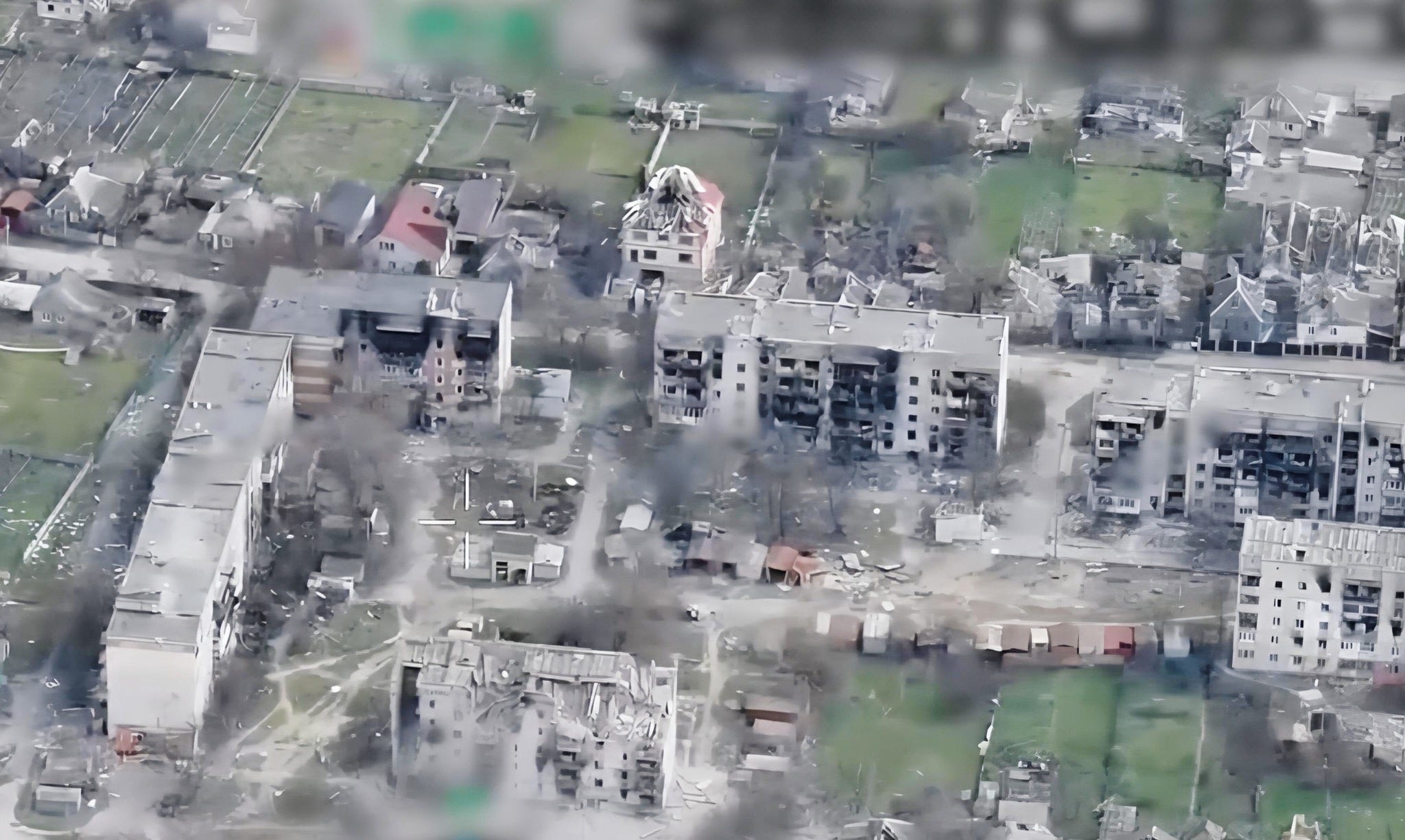
Humanitarian Crisis: Hunger and the Siege
In January 2026, in the Russian-occupied Kherson region, Alyona’s husband was injured by a Russian drone and briefly admitted to the hospital before being sent home without medication. The facility lacked medical supplies, running water, gas, and electricity, and the generator fuel had run out. Back home, without heat or power, Alyona washed bandages by hand with water melted from snow and boiled the last three potatoes on the fire outdoors. Her phone running low on battery, she called a cousin and said she was uncertain whether they would survive. By March, her cousin had still heard nothing and comforts herself with the knowledge that phones cannot be charged and communication lines are down. Her concern is heightened by reports that residents across the occupied Kherson region are dying from starvation, cold, and attacks by shelling and drones.
“Today, in the temporarily occupied Oleshki, about two thousand people, including fifty children, are forced to survive in conditions reminiscent of the Holodomor of 1932-1933,” said Oleksandr Prokudin, the head of the Kherson Oblast Military Administration, in an interview with Meidas Defense. “The Russian military has driven the city into a blockade. People have no food, medicine, fuel, or electricity. There is no food supply or evacuation. People are faced with a terrible choice: to wait for death by starvation or to walk miles along mined roads in search of a piece of bread, at the risk of shelling.”
According to residents who spoke to Meidas Defense on condition of anonymity out of security considerations, the besieged city of Oleshki in the Russian-occupied Ukraine is facing a humanitarian catastrophe. At least six eyewitnesses confirmed that food supplies are nearly exhausted. The market is destroyed, and shops are closed. A large food market in the nearby village of Kopani was closed due to the drone attacks. Humanitarian aid deliveries stopped.
Tetyana Hasanenko, the head of the Oleshki City Military Administration, based in the de-occupied territory after escaping from the Russian-occupied Kherson region, collects the evidence of the Russian war crimes, finding the limited opportunities to speak to neighbors, acquaintances, chats, and telegram channels.
“In the last three months, the residents have suffered from a lack of food and proper medical care,” said Hasanenko in a Zoom interview. “All roads were mined. In winter, as the mines were invisible under snow, the residents of Oleshki could not travel 31 miles to Skadovsk, the regional center, to get provisions, withdraw cash from an ATM, apply for social assistance, or receive pensions. None of these services is available in Oleshki. People barter, exchanging remaining products and materials.”
The Russian military, also cut off from the outer world and starving, followed suit in their own sinister way: they allowed civilian vehicles to bring in food supplies in exchange for 80% of the deliveries. Still, getting in and out is next to impossible. All transport moving along the road referred to as “The Road of Death” is targeted by drones and shelling. In March 2026, the last functional ambulance exploded on a mine there.
Even if delivered, the supplies rarely make it to the people. On March 5, two vehicles managed to bring in provisions. Olehski buzzed with rumors. By morning, a long line gathered by the grocery store in anticipation of getting the necessities. Instead, four drones attacked the gathering, wounding ten and killing two civilians. The wounded were transported to the hospital in a wheelbarrow.
In late March, local Russian press reported that “people were being admitted to the hospital with fainting spells and malnutrition” and that Ukrainians “dropped 15 boxes of humanitarian aid from drones throughout the city: three boxes each, two with food, and one with medication.”
There are reports of robbery and murder for food by Russians. Russian soldiers killed an elderly man who attempted to prevent them from stealing supplies from his cellar.
Adding to the food crisis, the water supply has collapsed. Since the destruction of the Nova Kakhovka Dam on June 6, 2023, high-rise buildings in Oleshki have had no running water. In 2023–24, Russian-installed tanks provided intermittent deliveries, allowing residents to fill containers, but these stopped more than a year ago. Only those in private houses can access well water, which is not tested for safety. Others relied on melted snow during the winter.
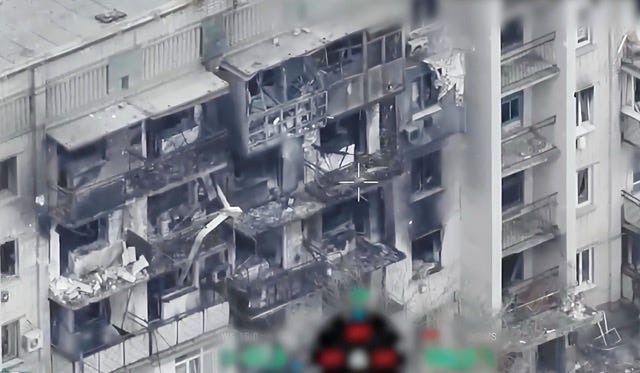
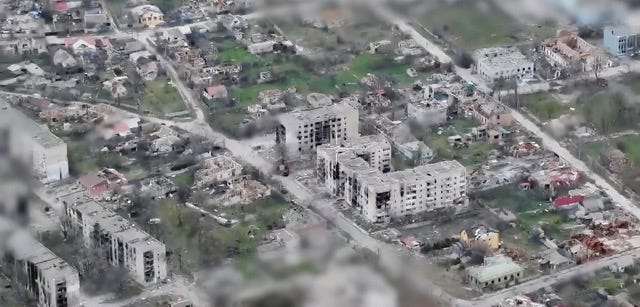
Rising Mortality: The Collapse of Civilian Life
The collapse of food and medical access is now translating into a spike in mortality: two or three deaths are reported daily, according to Hasanenko. The hospital is only treating Russian military personnel. Even before the current crisis, the hospital was mainly used to install Russian administrative control, declining medical care for residents refusing to get a Russian passport. Patients were kept in the hallways for hours while the Russian passport was processed.
The causes of death include malnutrition, heart attacks, traumatic amputations, blood loss, and hypothermia amid a severe winter and a prolonged heating crisis. In some apartments and houses, residents froze to death. One source who left the city reported that neighbors discovered the frozen body of an unidentified woman in her apartment. Power was cut at the end of 2023 after shelling destroyed critical infrastructure. Gas supplies have been shut off since spring 2025. Although Russian authorities announced repairs to damaged pipelines, no work was carried out, citing security risks. Inspection teams identified major leaks and extensive damage but closed the pipelines instead of restoring them.
“Human safari” attacks and artillery shelling also result in deaths and injuries. Russian FPV drone operators use moving targets for training, including civilians, vehicles, and animals.
Hasanenko is keeping statistics on civilian deaths, and according to her, there are 318 victims, including 246 wounded, and 72 dead. These numbers include only the residents who were identified. In many cases, identification is not possible.
A funeral in Oleshki is extremely difficult. The occupiers require a certificate of examination of the deceased, which can only be obtained in Kalanchak or Skadovsk via driving the Road of Death. On the rare occasion when funerals happen, garbage bags serve as coffins. Several contacts reported that bodies are left in the streets, consumed by stray dogs.
In mid-March, one former Oleshki resident contacted Hasanenko to seek help with collecting her father’s body from the Road of Death. The body stayed there for more than a month, and stray dogs were tearing it apart. Even though the daughter found a person ready to bury it, she could not find a car. Closer to the river, the bodies of killed Russian soldiers become food for wolves and bears.
More bodies are stored in the Oleshki morgue, which has not had electricity for four years. In mid-March, the morgue was hit by a shell. Although the morgue is full, Russians do not allow burials.
Occupation Tactics: Erasing Ukrainian Identity
Man-engineered humanitarian catastrophe comes hand-in-hand with the Russian occupying authorities’ systematic campaign to erase Ukrainian identity.
Russian propaganda channels are spreading the message that civilians still residing in the occupied territories are not welcome in Ukraine and that the Ukrainian pension is not sufficient to survive. Most residents are pensioners, and it is a challenge for them to obtain alternative sources of information, even though Ukrainian radio waves are reaching the left bank due to the proximity to the city of Kherson. Fake Ukrainian leaflets dropped by drones and slapped on the walls threaten the locals, claiming they were “collaborators.”
The occupying authorities continue to maintain strict surveillance and control all communication. Many are reported to be arrested for pro-Ukrainian views. People are disappearing. Some are kidnapped. There are provocations: Russians put up Ukrainian flags in the street and watch for people’s reactions to arrest those who react with sympathy.
Recently, a family from a village closer to Skadovsk was stopped at the checkpoint, and the Russian soldiers found a Ukrainian bank app in a man’s phone, even though it was previously deleted. The Russians followed the husband and wife back to their private house, where they searched, breaking walls and looking for hidden cash, accusing the family of collecting donations for the Ukrainian army. The couple was tied to the chairs, needles pushed underneath their nails, and the Russians threatened to take them to the torture basements.
Sexual violence has long been used by Russian forces as a tool of control. Residents spoke of multiple known cases of rape by Russian military personnel in occupied areas, with some women giving birth following these assaults. The alleged perpetrators are redeployed or killed in combat.
Reporting violence in Oleshki is not possible, as the closest Russian police station is in Vynohradovo.
“These horrors and suffering have no place in the 21st century,” said Prokudin, the head of the Kherson Regional Military Administration.
Sharing a video of residents singing at the ruins of a church, the head of the Oleshki Regional Military Administration, appealed to the global community for support, adding, “People do not lose faith in life… In such a time, in such conditions, our people rally and support each other. That’s what makes us a community. And that’s what makes us strong. No matter what occupier comes to our land, we are together.”
This is sickening that the Russians are getting away with the genocide of vulnerable people!!!! Horrible! Shame on Trump for cutting off major funding.
Thank you for your reporting of this tragic situation. I wish more Americans could see this.